Wednesday, August 19, 2015

Polar Shift

“A Novel from THE NUMA® FILES” and “A Kurt Austin Adventure” is a blend of science fiction—with “the scientific discovery of the century” repeated here and there—and 21st century (2004?) international action thriller. The bad guys have Gant and Margrave at the head of the pack, working for the same purpose but with opposing reasons: They want to cause a geological polar shift by bombarding the earth with electromagnetic energy so as to cause a disruption in the world’s telecommunications systems, believing it would be temporary. But the actual fact is that once the shift starts, there will be no halting it, with the destruction of all living things on earth in its wake. While Margrave’s intention is to force the “Elites” that surreptitiously rule the world via multinational corporations to a bargaining table, Gant actually wants to take over the political world order by owning the world’s telecommunications facilities shortly after the “temporary” disturbances. Gant is a ruthless maniac that would go to any length to achieve his aim, giving orders to eliminate anyone that might pose a threat without blinking an eye. The good guys have Austin and some brilliant and beautiful people leading them, doing their damnedest to first, ensure that the grand-daughter (Karla) of a dead electrical genius (Kovacs) that might possess the “antidote” for a polar shift attempt is not eliminated by agents of Gant, then second, race against time to apply the antidote to checkmate the bad guys.

The author’s major aim was probably more to entertain. When the plans of Gant and Margrave became known to Austin and his team, I was left wondering why they didn’t just put them under arrest. Instead the author let them attempt to unleash their hidden agenda, so that Austin and his people will have something to keep them busy, trying to stop them.

The “the scientific discovery of the century” finally turned out to be living “dwarf” mammoths and a crystal city found inside a spent volcano in a remote Siberian island named Ivory Island. The mammoths were miniature versions of their giant ancestors, previously thought extinct, but now thought to have survived by adapting to the diminishing food sources. The people that built the crystal city inside the mountain had been smart enough to domesticate the mammoths and used them as beasts of burden much the same way horses have been treated.

Monday, August 17, 2015

Abyssinian Chronicles

Originally published in 1998 in Amsterdam as Abessijnse Knonieken, this book is about life in Uganda from the late ’60s to the late ’80s with emphasis on the religious and sociopolitical developments. Told in an all-knowing first-person narrative, it is an account of developments around Mugezi, an Ugandan boy, from birth in a village, to myths and beliefs of villagers, to growing up with the grandmother in the village, then in a strict Catholic family in Kampala, school life in the city and sexual exploits, life in the seminary, the impact of political upheavals from Obote to Idi Amin and back to Obote and guerrilla fighting, to life in university and then as a teacher, to the sometimes suspect role of relief agencies, and finally to life in Amsterdam living among Ugandans in the “Ghetto” and then among whites.

Very interesting, and reveals how similar to Nigeria Uganda is in terms of common colonial past, control of the economy by foreigners, North-South ethnic divide, religion (Islam, Catholics, Protestants, local practices), cultural practices and beliefs (witch doctors and their followers), civil war. Particularly interesting was how Mugezi could easily buy for himself a British passport with birth certificate to match, and how in Amsterdam girls sold their bodies in glass cage displays.


Sunday, August 16, 2015

Tinker, Tailor, Soldier, Spy

In the British intelligence organization (Circus) one of the top brass (Haydon) got unhappy about the West and decided to work for Russia. He was hired by Karla the mastermind of the Russian spy agency (Moscow Center) to play a game of double cross from within the London Circus. Karla cooked up a plot for Haydon to play to his colleagues in the Circus, that they had an agent in Moscow (Merlin) gathering secret information for them about Russia. A secret agent at the Russian Embassy became the go-between between Merlin and Haydon (alias Gerald to the Russians) under the “Witchcraft” plot by Karla. Haydon though uses this ploy to hide the fact of his working for Karla. The old man in charge of the Circus (Control) got suspicious particularly as he was left out of the Witchcraft club. When this got to Karla he draws up another plan which successfully removed Control through humiliation and death by heart attack.

The Circus was reorganized, with the top people who were loyal to Control being shoved out. Then something unexpected happens and top detectives who heard it began to smell a rat again. Secretly, they ask Smiley who had been Control’s next in command to investigate the past and present in order to discover who was secretly working for Karla. The complete story comes out in the course of his investigation, which was successful in picking out the mole Gerald as Haydon. Has a taste of The Fourth Protocol in having a British citizen secretly working for Russia, but perhaps not as interesting as The Little Drummer Girl.

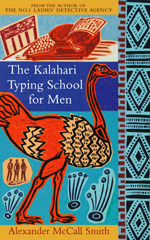
The Kalahari Typing School for Men

This book is generally about the people and culture of Botswana, a country termed a shining beacon in Africa, a quiet traditionally cattle-rearing people with high moral standards that are somewhat being eroded by modernity and city life. I’ve learnt the most from it about Botswana: The city of Gaborone that used to be called Chief Gaborone’s Place, some other towns and places like Mochudi, Francistown, Lobatse; the widely respected first president that instilled in people the abhorrence of corrupt practices in government, the low population of about two million people many living in rural areas rearing cattle, the manner of referring to males as Rra and females as Mma, the dry weather that made water precious to the people and the land, traditional norms of greeting and courtesy to people, the love for football, and so on.

That is the skeletal framework for the story. To dress it up is a cast made up of two ladies running the country’s first detective agency (The No. 1 Ladies’ Detective Agency) that have teamed up with a man and his two apprentices running a mechanic workshop (Tlokweng Road Speedy Motors). The senior detective and owner of the agency, Mma Precious Ramotswe, is engaged to the owner of the workshop, Mr. J.L.B. Matekoni and they have agreed to foster two orphan children. The story brings out a number of incidents in the lives of every one of these people, beginning with Ramotswe’s worries about the fact that her assistant, Mma Makutsi, is a single lady with no suitor.

It is Makutsi that thinks up the idea of setting up a school to teach men typing in secret to save the men from the possible embarrassment of being seen to be learning a woman’s job. In the process one of her students falls in love with her, lying to her that his wife left him with their kids for another man. Though it turns out the wife didn’t actually leave him, he just felt unloved at home. When the wife goes to Ramotswe to get her to find out what the man has been up to, she now has the problem of breaking up the affair without hurting her employee. And this sort of works out quite okay.

Then there is the story of Mr Molefelo, a client with a past he now wants to make amends for, following a near-brush with death, in order to free his conscience. In his younger days he’d gotten his sweetheart pregnant, had secretly robbed the family he was living with to get money for the abortion, and had dumped the girl. Now over twenty years later and after becoming a successful businessman, he wants to find the family and the girl and apologize and give them money if necessary. This also works out well, thanks to the skillful handling by Mma Ramotswe. She finds the family (less the man who’d died) and arranges for a reconciliatory meeting between the widow and Molefelo. She also finds the dumped girl now a happily married woman with kids, and convinces Molefelo to help pay for the education of the woman’s daughter that now wants to be a nurse, since the woman herself could not go on to become a nurse because of the abortion.

The language is rather simple and formal, and it appears the way the cultural habits are explained, the audience is people outside Botswana. One gets the feeling that Africans or at least those from Botswana’s cherished past, were honest, courteous and kind people that loved cattle and the land.

Tuesday, August 11, 2015

The Negotiator

This is a long but interesting conspiracy tale. The Soviet Union is facing an energy crisis, with dwindling oil reserves and production. They will have to import more from abroad, and to finance the imports less funding will have to go to military spending. Their military chief personally would rather invade Iran for their oil. But Gorbachev is in power and it is the era of perestroika and glasnost, so the military leader’s plan for invasion had to be kept in the cooler.

Following the visits of their leaders to each other, an arms reduction treaty is hammered out between the US and USSR. When in effect, it would lead to reduction in military spending with savings amounting to hundreds of billions of dollars. Due to following reduction in military budgets, it will also lead to the bankruptcy of some defense industries, especially in the US where investments had been tied up in the manufacture of advanced weapons. A group of five Americans conspired to force the American President Cormack to resign, by kidnapping and murdering his only son, but making it look like the Soviets were responsible. This would prevent the arms reduction treaty from coming into effect. With the cooperation of some highly placed military men in the Soviet Union who also did not want the treaty to be ratified, the kidnap plan was effected.

In comes Quinn as the negotiator, charged with securing the release of the president’s son from the kidnappers. Relying on skills and experience from negotiating release of kidnap victims in the past, he manages to effect the release of the US President’s son, Simon. But unknown to Quinn the US cabinet and even the CIA people working with him had been compromised by the conspirators, who did all they could to increase the president’s pain over the kidnap and render him unfit to govern. A belt concealing a bomb had been planted on Simon and after he was released, the compromised CIA agent used remote control to trigger the bomb.

The death of Simon nearly led the president to resign as the conspirators wanted. So they were feeling happy about the execution of their plan. Until Quinn, aided by the new intelligence leadership in Russia, managed to checkmate and expose them at the last minute.

The author unfolds the plot without emotion, leaving gaps here and there for the reader’s imagination. He mentions Biafra in the discussion of European and South African mercenaries.

My Once Upon a Time

The vicinity is the tough neighborhoods of East London, versus the richer and whiter West London. Boy is a private eye formerly in the paid service of the government, now freelancing. A mysterious man turns up and pays him the biggest advance he’d ever had for any case, forty grand. And all he has to do is to find a particular special woman to be his queen in his country-side estate, within seven days. He thinks it’s going to be easy, until unusual things start happening.

We are taken through the various sides of the city, the street hustlers and drug dealers, the life of the rich in a black-life resort located in the west, nightclub and show violence, hired thugs, and the spiritual lord known as the Race Man, the sport of cricket and an annual event between the West and the Rest. Boy manages to find the woman at last, but falls so in love with her that he’d rather kill his client than give her up to him. He discovered much too late that the man was after all a god known as Eshu (the fallen patron’s saint), and that he had been sent to him. The result of his stabbing the man to death was that he too had to fall.

Author: Diran Adebayo

Monday, August 10, 2015

The Perk

A very interesting thriller, plotted from so many angles, but with one central theme—the meaning of justice. The hero Beck Hardin left his small town of Fredericksburg near Austin, Texas a teenager angry with his father J.B. Hardin after his mother died, angry with the discriminatory justice meted out by the town judge Stutz. Twenty-four years later he is forced to return to the small town because his own wife has died from cancer and he is unable to raise his two children by himself; they go back to his father who is still very much alive.

Four years before Beck’s return, Heidi, the beautiful daughter of Beck’s high school best friend Aubrey, was killed by a cocaine overdose and found dumped in a ditch. Because of a debt Beck owed Aubrey, Aubrey now wants him to find the killer of this daughter before the time runs out, so that justice could be done. As the story unfolds, Beck is elected the new judge, by a curious stroke of fate, and he quickly finds out why the favored candidate had to drop out at the last hour. As Beck investigates Heidi’s case, he discovers that Heidi’s mother Randi, who divorced Aubrey shortly after Heidi’s death, had in fact contacted the man responsible for her death, movie star Chase Connelly, who settled her with a mansion in Austin and $25 million to be paid over several years but provided she would keep her mouth shut. So now, would it be justice to expose Chase and deprive Randi of her settlement wealth? Beck thinks so.

However by the time he manages to get Chase’s DNA matched with that of the semen found inside Heidi’s vagina, the time for conviction of the culprit has run out. The positive DNA result comes in 57 minutes late. But while the law fails to catch up with Chase, something else does: Heidi had been HIV-positive before Chase had his way with her in his limo. And so had transmitted the virus to him, or so it seemed. When Chase turns up in his courthouse the night he is supposed to be convicted, it is Beck that has to give him both the good news—that he won’t be tried for lack of time—and also the bad—that his blood had tested HIV-positive and that he’d been infected by Heidi.

Some of the other interesting angles to the story include the issue of racism. The whole county had just one black person and so the racism portrayed wasn’t the usual white against black, but white against brown: Between the Anglo residents of Fredericksburg and the mostly illegal Mexicans, living in a barrio (slum) part of town and doing menial jobs for very low wages. There is the issue of sports as big business and how kids were taught by society via the TV and movies to cheat to win at all cost, if they could get away with it. Another is the issue of how the town was run by German descendants who would go to any extent to keep outsiders out. There is segregation in the kids’ schools, with Anglo and Mexicans being taught separately. Then there were two female friends that moved into town years before. They lived together and did nothing to dispel the false rumor they were lesbians, but only for selfish reasons—not wanting the lonely farmers to bother them for wives. Running through most of the book was the discovery by Beck that he had failed in his duty as husband to his wife and father to his children while the wife lived, as he now has to read how the wife told his father via email the story of their lives, her sickness and her evaluation of him.