Wednesday, November 4, 2015

The Street Lawyer

“The Street Lawyer” could have been the narrator, Michael Brock, an antitrust lawyer who’s been slaving it at the big law firm of Drake & Sweeney for seven years as an associate, with a few years left for him to make full partner and earn big bucks. And it could also have been big, knowledgeable, caring and competent lawyer Mordecai Green whose 14th Street Legal Clinic has been catering to the needs of the poor and homeless for many years. And without him, much of the achievements in the story might not have taken place.

Having noted that, the story is one that highlights the plight of the poor and homeless, living in big American cities in the midst of wealth and plenty. One of the poor and homeless, DeVon Hardy, decides to take it upon himself to do something to force some people to notice, even it costs him his life. He and 16 other tenants in an abandoned warehouse were improperly evicted as “squatters” when in fact they had been paying $100 monthly rent, thrown out into the cold February streets of winter in Washington, D. C. He steals a gun and dresses up to look like he had sticks of dynamite wired around his body, ready to explode when he pulls a wire. He traces the firm of lawyers that handled the eviction, Drake & Sweeney, goes there and takes Michael and some of his fellow lawyers hostage, terrorizing them for a while and reprimanding them for making so much money without a thought for the poor. Wrongly thinking that he aims to harm his victims, high-powered hostage rescue teams are drawn up outside, and at their first opportunity at aiming a shot at him, he is gunned down. Right behind him is Michael Brock that he’d made spokesman for the hostages, and the experience of coming so close to death, of having Hardy’s brains and blood spilled on him, changes him thereafter.

Hardy had brought up the 14th Street Legal Clinic while he interrogated the hostages, so Michael goes there asking around. First he wants assurance that Hardy wasn’t HIV-positive. Then he gets more involved, and either for guilt or something else, he quits his big firm job and joins them. When it becomes clear that those 17 people including Hardy were wrongly evicted, leading to some deaths, Drake & Sweeney is hit with a law suit by the 14th Street Legal Clinic, spearheaded by him and Mordecai. They have to beg for out-of-court settlement to avoid being seriously damaged further in the press. Very interesting reading indeed.

Friday, October 23, 2015

The Broker

“The Broker” is Joel Backman, once head of a prestigious law firm that specialized in high-powered lobbying of American lawmakers and politicians. His final deal involved peddling a software system designed by Pakistani hackers to neutralize the most sophisticated but secretly deployed satellite surveillance system to the highest bidder—the Chinese, Saudis, Israelis. After some money changed hands, he is arrested by US authorities on trumped-up charges. The people that paid transaction money for the software felt shortchanged, while those that built the satellite wanted him and the software at all cost. To avoid their wrath he pleads guilty to charges so he could be hidden away in prison for 14 years.

But only a few months down the line the CIA that is still puzzled about the secret satellite decides to get the out-going US President to pardon Backman conditionally. Their plan is to hide him in a foreign place and after a while leak his location to those that might want him dead so as to find out who would go after him, believing those people would have the highest interest in the satellite. Backman agrees to the deal though without knowing why he was being released. He is ferreted to a new home in Italy using two different names. In the course of his learning Italian, paid for by the CIA, we are treated to some Italian art and cuisine and history. He also falls in love with one of his tutors, a woman that later saves his life by giving him her dying husband’s passport and changing his looks to match the photo in it. Unknown to the CIA that are controlling his new life in Italy, he makes contact with his lawyer son in the US who secretly sends him a smartphone with which they communicate. He manages to escape death at the hands of the trained killer agents from China and Israel, goes back to the US without the knowledge of the CIA that had agents watching him, and eventually buys some safety for himself by releasing the powerful software to the US army. In exchange he’s provided two identities, two passports, and a promise to intervene with the foreign powers that had been after his life because of the software.

The story touches on how the CIA relates with the American president and their role in establishing or influencing American foreign policy. A new US president is shown asking the acting CIA director what step should be taken for the best American interest. Then there is the realization that your own American government could secretly want you dead, especially if its laws can’t get you. They can also hide you by giving you new identities, which means what some crooks do in selling stolen or forged passports and such is also done legally. The methods of grooming lethal agents to kill and speak many languages so as to be able to disguise as nationals of many nations comes to light in the character of the Chinese, Sammy Tin. How secret agents go about their job of trailing their targets, being able to shoot with skill, to kill and disappear without evidence is also shown. There is mention of how non-Americans are treated shabbily by immigration officials at airports. Kwytemail is introduced as a public but very secure email system, and Backman’s very hard to guess (and long) password could not be broken even by agents of the CIA when eventually his smartphone is discovered and covertly stolen by them. When his smartphone gets taken, Backman has to quickly learn to use a cyber-cafĂ© to go online. And the Swiss as being bankers for the world’s illegally-acquired loot also come to play. In all, an interesting and exciting plot to read.

Thursday, September 3, 2015

Man of the Hour

This is a story of the Palestinian-Israeli conflict, played out in New York several decades later. It’s the story of the Hamdy family, parents that left the Middle East to begin life in America, mother that held on to her traditional Muslim beliefs and even killing herself to avoid further humiliation, the father that married an American woman afterward and wanted to live in peace; the bitter son Nasser who slowly got entangled with terrorists, and the bright and beautiful first daughter Elizabeth. It is the story of Arabs in America, the ones for peace, and the ones for revolt by violent means as a way of communicating their resentment at America’s support for their perceived oppressor, Israel.

It is also the story of teenagers growing up and attending high school, being taught to think for themselves and make decisions on their own by their teacher, David Fitzgerald. It is the story that examines the nature and meaning of being a hero. And it is a story that throws up the issue of divorce and the fight for custody of kids. Very thrilling to read.

Orimili

A philosophical Igbo cultural story set mainly in the 1940’s. The main character Orimili took this name from a nearby river in the town. He was hardworking and probably among the wealthiest, but his application to join the ozo society governing the town met with some resistance, the stated reason being that his great-grandfather had come to the town from somewhere and not born there. Because of this he’d always wanted to do things to root his family properly in the town.

The decision of his son to marry in Britain without his permission—after he’d begun arrangements to marry his friend’s daughter for him—turned his life upside down. The ozo title was however given to his son as an honor for being the first foreign-educated in the town and more-so being a politician.
It is rather a slow-paced story with page-long paragraphs, 90% thought and 10% action. The use of gods to explain life in the traditional society sometimes appeared too ridiculous. There seemed to be a god for almost everything—the land, river, crops, etc.

An Error of Judgment

This novel centers around a doctor of a broken marriage who is convinced there’s something bad about him, deep down, an urge to destroy. He tries to run away from himself, first by quitting medical practice, where he sees himself as enjoying the destruction of disease. He becomes a consultant and sets up a night club for lonely people. Again he quits this, feeling he might have been motivated by the same need to cause harm and enjoy pain.

A lifeline plot revolves around the murder of an old drunk woman by three teenagers one night. Afterwards there is a new young “patient” in Setter’s club. Initially Setter suspects him of knowing something about the murder. Later, he is convinced that Sammy was the one who did the most in killing the woman. He pays close attention to Sammy and then gets him to confess his act. He does not inform the authorities, however takes it upon himself to wield judgment—death. First he takes Sammy to France so that Sammy could enjoy himself. He tests Sammy further and realizes that Sammy has no conscience, has no dreams, and could kill again in the right circumstances. He then carries out judgment by advising Sammy to take a certain amount of alcoholic drink and a certain amount of his doctor’s prescription, that he would feel better the next morning. Sammy follows his advice and is discovered dead the next morning.


Mayombe

Pepetela is the pen-name of Artur Pestana, or Artur Carlos Mauricio dos Santos. He was a half-caste Angolan who participated in the liberation struggle of the MPLA (People’s Movement for the liberation of Angola) in the early 1970s. This tale was based on his experience of the struggle. The original version in Portuguese was translated in 1983 into English by Michael Wolfers.

The story highlights the exploitation at the bottom of liberation struggles, and brings about the personalities of the types of people that take part in the liberation struggle, told mostly in third person, with first-person snapshots of the thinking of the key characters: Theory who is half-white and in the struggle to prove his commitment to the black people; Struggle the only person from the Cabinda area whose people were generally seen as traitors. Fearless the commander from the Kikongo tribe, who has grown into an old man of war at thirty-five seeing no role for himself once the struggle was won. The Political Commissar who was Kimbundu and under the shadow of the commander until the commander decides not to wade into his sexual problems with Ondine and then starts resenting him. And so on.

The plot is short, two missions from a base in the Mayombe forests interspersed with the scandal of a leader comrade (Andre) being found out after he’d had sex with a female comrade (Ondine) in the bush at Dolisie. But it generally draws out the play of tribalism within the members of the group, the distrust and arguments about tribal domination and past conquests. During the second and last mission, the commander and Struggle are killed but more in an effort to defend the position of the Commissar: A Cabinda and a Kikongo died to save a Kimbundu. So the message was clear that tribalism was a problem to be discouraged among the African peoples.


Friday, August 28, 2015

The Russia House

It is two years after perestroika. Although the leaders of the US and USSR are hugging each other on TV it’s still cold war for their spy networks. And while the doves in the US government are asking for cuts in military spending the hawks are screaming for more. Yakov is a rebel scientist who wants to expose the defects in Russian technology. When his secret documents find their way to the secret service of Britain and US, Barley is recruited and trained in spy work then sent to Russia to establish the genuineness of the source, because the documents were sent to him to publish as a novel, by Yakov whom he met during a visit to Russia.

Barley gets to Russia and falls in love with Katya, a friend of and his contact with Yakov. After his first trip as a spy he is taken over by the Americans who have more at stake in the secret coming out. He agrees to continue and returns to Russia. By this time Yakov had been detained by the Russian authorities. Barley began to suspect this when he noticed that he and Katya were being watched, and again from a letter from Yakov which wasn’t in his usual style. He works out a plan to save Katya and her two kids and puts this into effect when Katya herself learned in code from Yakov that he’d been held. This involved his leaving the British and American secret services to work with the Russians. Katya and her relations were not detained as a result, though Yakov died of illness. After a year in Russia he was in Lisbon, preparing for the arrival of Katya and the kids to join him.

Maru

A thoughtful and poetic little novel about racial discrimination in Botswana against the Bushman people. When the orphan daughter of a Bushman who was raised by an English missionary grows up and goes to teach in a remote village she becomes the target of contempt and hatred by both adults and children, who had taken it for granted for too long that Bushmen (of the Masarwa tribe) were only on Earth to be their slaves. Then two prominent men fall in love with the lady and wage war against each other for her sake, the first time since their long years of friendship.


Tuesday, August 25, 2015

Altered States

Eddie Jessup is an ex-religious scientist investigating altered states of consciousness. He goes to Mexico and joins an Indian tribe in a mushroom smoking ritual, where he experiences a sense of return to an earlier period in man’s evolution. He takes some of the mushroom stuff back to the lab where the active drug was identified and then synthesized. In an effort to study the drug’s effects further, he takes some and goes into an isolation tank, with some colleagues standing by to observe. He transmogrified into an earlier man-form and x-ray pictures proved it. His colleague could hardly take in what happened and tried to discourage him from further testing himself with the drug. Some felt he was getting mad and out of hand, and his wife just returned from Africa on a study was constantly worried for him.

He takes the drug again and enters the isolation tank, alone this time. He changes into an ape-like creature, attacks some of the college staff working the night, follows a pack of dogs and ends up in the African Savannah section of a zoo, where he changes back to normal human form and is found naked asleep by a night guard. His wife and colleagues could hardly believe him and he tries the experiment again under their eyes, to convince them. This time he turns into a black ape and his colleagues do some tests and take blood and tissue samples. But after they leave him he continues transgressing backwards, to the horrifying beginnings of the planet, and is about to turn into thin air but for his wife who could no longer stand it and rushes in to hold him. A terrific climax to a story about a drug that could change one physically to an earlier evolutionary form lasting 4 hours.


The Garbage King

The Garbage King is the gang name given to Mamo, a poor orphan teenage boy forced to live in the streets of Addis Ababa for survival, following the death of the sole breadwinner, the mother, and after an ordeal in the countryside as an enslaved cattle boy. His is one half of the story. The other half is about Dani (Daniel), the spoiled fat son of a rich, popular but very strict man. Dani is not popular at school, not being athletic, not exceeding in science subjects, much to his dad’s displeasure. When he fails most of his exams one more time, his dad decides to send him to a remote countryside place, to a harsh disciplinarian that should put him straight. But rather than spend a day with the dreaded Feissal, Dani decides to run away from home.

The two boys are brought together when they end up sleeping in a cemetery by sheer chance. Dependency and friendship develops and the two are shortly taken in by a nonviolent street gang as members. Dani undergoes the sort of change that the dad wanted in the first place as he learns to survive in the gang, losing his spare fat, becoming lean and watchful. Accounts of the methods of survival in the streets were given, begging, sleeping wrapped up in blankets in the open, foraging through garbage particularly those of restaurants for thrown-away food, doing the toilet in the open waste grounds, showering in nearby rivers. The gang members were happy to share out Dani’s rich clothes at first. But because he really was not poor and homeless like them and he could not do the begging like them (as he could be recognized and then reported to his dad) he was often looked down upon, with the exception of Mamo that usually stood for him. Until he begins writing stories down and Mamo succeeds in selling them for the group. But this very act that sealed his acceptance in the gang was to sow the seeds for his later discovery by the dad who had called up all the people he thought Dani could run to without hearing anything about him. One of Dani’s stories got sold unknowingly to a teacher in Dani’s school, to Dani’s own teacher in fact, who quickly recognized his handwriting then went to see the dad.

Things end happily for everyone, with Dani going back with his father once he was assured he would not be sent to Feissal, and Mamo also going to live with his newly married sister, starting night school to learn to read. The story appears written with kids in mind, with conscious attempts made to avoid explicit language regarding sex, like using “doing it.”

Monday, August 24, 2015

Strip Jack

Inspector Rebus novel number 4. This one is set in Edinburgh, around a clique of people that had been friends in earlier school days, a couple of women and four guys. The story is woven around the personalities of members of the group, most prominent being Gregor Jack who had wormed his way to the position of a Member of Parliament.

The story opens with a raid at a high-class brothel in which Jack was one of the men “caught.” It looks like he’s been set up, so the question becomes why and by whom. Then his wife is found murdered and dumped in a river, and a high profile murder investigation starts. As the plot unfolds, we are told the reason Jack visited the brothel was to see his estranged sister. Someone had called him and told him his sister was there. This was how he was set up, and it was one of the members of the clique, someone that happened to be in love with his wife.

As the investigation winds to a conclusion, it turns out that it was Jack himself that murdered his wife in the course of a violent argument following the publication of his scandalous visit to the brothel. He is about to murder the man responsible for that blow to his public image when the cops turn up. In the scuffle that follows, he ends up jumping into another river, in an apparent suicide mission rather than facing arrest and imprisonment.

Under the Frangipani

This is the story of poverty and corruption in the changing society of post-colonial Mozambique. It reflects the nature of white/black relations in the country during colonial times when whites always assumed supremacy, at independence when a lot of whites fled the country to Europe or other white lands. The story, a collection of accounts from selected inmates of a port that had stored slaves in the past, then prisoners of war, and now old people, told with spicing of traditional Mozambican beliefs.

Following the liberation struggle corruption has set in and the old ways are being abandoned. Old people are being ignored or insulted or robbed even by their relations. The mulatto head of the fort (Vastsome Excellency) has died under mysterious circumstances, and a policeman (Izidine) is sent to investigate. His investigation is a series of interviews with the old people, a curious mix of characters, including a white man that refused to flee to Europe with his wife and child, a cursed “man-child” that aged to an old man the same day he was born, and a witch that supposedly turned into water at night. Each one claims to have killed the dead man for his/her own reasons. But then towards the end the truth is revealed by the witch in a sort of trance: That the fort had concealed arms and the old people had destroyed the arms with witchcraft. But when the military men in the know came for the arms and found it gone, they took out their revenge on Vastsome. And now even the policeman that was sent was not safe as he too had been penciled down for elimination. But then again due to witch craft or whatever, the men that were supposed to come and kill him get blown up in terrible stormy weather at the end.

Saturday, August 22, 2015

The Man With the President’s Mind

This is a thriller about the Cold War timed in the late sixties. Having had to accept defeat over the Cuban affair on account of President Kennedy, the Soviets are plotting to regain lost glory. To ensure success they need to have a way of predicting American reaction to each of the moves they would make. Operation 471 was created for this: A man with a background similar to the US president’s (Levin) was picked out to live an American life in a replica of the White House, and receiving most of the material that went to the US president, with the main objective of predicting how the president would react to events.

In the first few months things seem to be moving pretty well as Levin’s predictions come true, and the Soviets begin feeling overconfident. The site of the operation is secretly moved to the US itself. Levin had refused going anywhere without his girl and so he was drugged. At the new location Levin finds out that his girl had been eliminated as a security risk, and that the Soviets didn’t just want to reunite Berlin and send foreign forces packing, but to take over Europe with World War III if it came to that. Realizing his government didn’t care much for individual life, he decides to escape from the new site and warn the Americans about the impending doom. He succeeds and the catastrophe is averted, but at a cost of his own life.

The Crippled Dancer

This is an Igbo novel in English, set somewhere near Aba apparently in the 1940s and fifties. It is a story about inter-family village quarrels, the struggle for power among adults and the lamentation of the elders about the changed youth of the day and the destruction of a glorious past by the ways of the white man.

Specifically it is a story of the struggle of one family to ensure the continuation of their line in the village. The object of this struggle is Ajuzia, whose mother died during his birth, and whose only-surviving-child father died during his youth. He is brought up by his grand parents, who impress on him the need to carry on the family struggles and war with other villagers early in his youth.
He could not reconcile himself with the young wife his grandfather married for him. But he takes on the family struggle personally after he and his grandfather were locked up for four days following a fight with Radio, a notorious son of the village, for having an affair with his grandfather’s wife. When Radio was killed by a speeding car, his grandfather was accused of using witchcraft to cause the death. The elders found the grandfather not guilty.

For a change something good happened—the grandfather rose to the position of senior elder in the village. But then their ancestry was challenged by Chief Orji. Ajuzia had to involve the father of his girlfriend at Aba who happened to be a police boss in winning this last fight, and in having the family’s prime enemy in the village locked up. So that war with the village enemies seemed won. But Ajuzia’s girlfriend was now pregnant. This was something his grand parents would rejoice for, but he first had to break the news to her violent father.

Wednesday, August 19, 2015

Polar Shift

“A Novel from THE NUMA® FILES” and “A Kurt Austin Adventure” is a blend of science fiction—with “the scientific discovery of the century” repeated here and there—and 21st century (2004?) international action thriller. The bad guys have Gant and Margrave at the head of the pack, working for the same purpose but with opposing reasons: They want to cause a geological polar shift by bombarding the earth with electromagnetic energy so as to cause a disruption in the world’s telecommunications systems, believing it would be temporary. But the actual fact is that once the shift starts, there will be no halting it, with the destruction of all living things on earth in its wake. While Margrave’s intention is to force the “Elites” that surreptitiously rule the world via multinational corporations to a bargaining table, Gant actually wants to take over the political world order by owning the world’s telecommunications facilities shortly after the “temporary” disturbances. Gant is a ruthless maniac that would go to any length to achieve his aim, giving orders to eliminate anyone that might pose a threat without blinking an eye. The good guys have Austin and some brilliant and beautiful people leading them, doing their damnedest to first, ensure that the grand-daughter (Karla) of a dead electrical genius (Kovacs) that might possess the “antidote” for a polar shift attempt is not eliminated by agents of Gant, then second, race against time to apply the antidote to checkmate the bad guys.

The author’s major aim was probably more to entertain. When the plans of Gant and Margrave became known to Austin and his team, I was left wondering why they didn’t just put them under arrest. Instead the author let them attempt to unleash their hidden agenda, so that Austin and his people will have something to keep them busy, trying to stop them.

The “the scientific discovery of the century” finally turned out to be living “dwarf” mammoths and a crystal city found inside a spent volcano in a remote Siberian island named Ivory Island. The mammoths were miniature versions of their giant ancestors, previously thought extinct, but now thought to have survived by adapting to the diminishing food sources. The people that built the crystal city inside the mountain had been smart enough to domesticate the mammoths and used them as beasts of burden much the same way horses have been treated.

Monday, August 17, 2015

Abyssinian Chronicles

Originally published in 1998 in Amsterdam as Abessijnse Knonieken, this book is about life in Uganda from the late ’60s to the late ’80s with emphasis on the religious and sociopolitical developments. Told in an all-knowing first-person narrative, it is an account of developments around Mugezi, an Ugandan boy, from birth in a village, to myths and beliefs of villagers, to growing up with the grandmother in the village, then in a strict Catholic family in Kampala, school life in the city and sexual exploits, life in the seminary, the impact of political upheavals from Obote to Idi Amin and back to Obote and guerrilla fighting, to life in university and then as a teacher, to the sometimes suspect role of relief agencies, and finally to life in Amsterdam living among Ugandans in the “Ghetto” and then among whites.

Very interesting, and reveals how similar to Nigeria Uganda is in terms of common colonial past, control of the economy by foreigners, North-South ethnic divide, religion (Islam, Catholics, Protestants, local practices), cultural practices and beliefs (witch doctors and their followers), civil war. Particularly interesting was how Mugezi could easily buy for himself a British passport with birth certificate to match, and how in Amsterdam girls sold their bodies in glass cage displays.


Sunday, August 16, 2015

Tinker, Tailor, Soldier, Spy

In the British intelligence organization (Circus) one of the top brass (Haydon) got unhappy about the West and decided to work for Russia. He was hired by Karla the mastermind of the Russian spy agency (Moscow Center) to play a game of double cross from within the London Circus. Karla cooked up a plot for Haydon to play to his colleagues in the Circus, that they had an agent in Moscow (Merlin) gathering secret information for them about Russia. A secret agent at the Russian Embassy became the go-between between Merlin and Haydon (alias Gerald to the Russians) under the “Witchcraft” plot by Karla. Haydon though uses this ploy to hide the fact of his working for Karla. The old man in charge of the Circus (Control) got suspicious particularly as he was left out of the Witchcraft club. When this got to Karla he draws up another plan which successfully removed Control through humiliation and death by heart attack.

The Circus was reorganized, with the top people who were loyal to Control being shoved out. Then something unexpected happens and top detectives who heard it began to smell a rat again. Secretly, they ask Smiley who had been Control’s next in command to investigate the past and present in order to discover who was secretly working for Karla. The complete story comes out in the course of his investigation, which was successful in picking out the mole Gerald as Haydon. Has a taste of The Fourth Protocol in having a British citizen secretly working for Russia, but perhaps not as interesting as The Little Drummer Girl.

The Kalahari Typing School for Men

This book is generally about the people and culture of Botswana, a country termed a shining beacon in Africa, a quiet traditionally cattle-rearing people with high moral standards that are somewhat being eroded by modernity and city life. I’ve learnt the most from it about Botswana: The city of Gaborone that used to be called Chief Gaborone’s Place, some other towns and places like Mochudi, Francistown, Lobatse; the widely respected first president that instilled in people the abhorrence of corrupt practices in government, the low population of about two million people many living in rural areas rearing cattle, the manner of referring to males as Rra and females as Mma, the dry weather that made water precious to the people and the land, traditional norms of greeting and courtesy to people, the love for football, and so on.
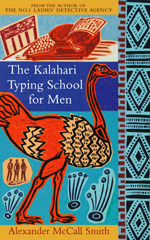
That is the skeletal framework for the story. To dress it up is a cast made up of two ladies running the country’s first detective agency (The No. 1 Ladies’ Detective Agency) that have teamed up with a man and his two apprentices running a mechanic workshop (Tlokweng Road Speedy Motors). The senior detective and owner of the agency, Mma Precious Ramotswe, is engaged to the owner of the workshop, Mr. J.L.B. Matekoni and they have agreed to foster two orphan children. The story brings out a number of incidents in the lives of every one of these people, beginning with Ramotswe’s worries about the fact that her assistant, Mma Makutsi, is a single lady with no suitor.

It is Makutsi that thinks up the idea of setting up a school to teach men typing in secret to save the men from the possible embarrassment of being seen to be learning a woman’s job. In the process one of her students falls in love with her, lying to her that his wife left him with their kids for another man. Though it turns out the wife didn’t actually leave him, he just felt unloved at home. When the wife goes to Ramotswe to get her to find out what the man has been up to, she now has the problem of breaking up the affair without hurting her employee. And this sort of works out quite okay.

Then there is the story of Mr Molefelo, a client with a past he now wants to make amends for, following a near-brush with death, in order to free his conscience. In his younger days he’d gotten his sweetheart pregnant, had secretly robbed the family he was living with to get money for the abortion, and had dumped the girl. Now over twenty years later and after becoming a successful businessman, he wants to find the family and the girl and apologize and give them money if necessary. This also works out well, thanks to the skillful handling by Mma Ramotswe. She finds the family (less the man who’d died) and arranges for a reconciliatory meeting between the widow and Molefelo. She also finds the dumped girl now a happily married woman with kids, and convinces Molefelo to help pay for the education of the woman’s daughter that now wants to be a nurse, since the woman herself could not go on to become a nurse because of the abortion.

The language is rather simple and formal, and it appears the way the cultural habits are explained, the audience is people outside Botswana. One gets the feeling that Africans or at least those from Botswana’s cherished past, were honest, courteous and kind people that loved cattle and the land.

Tuesday, August 11, 2015

The Negotiator

This is a long but interesting conspiracy tale. The Soviet Union is facing an energy crisis, with dwindling oil reserves and production. They will have to import more from abroad, and to finance the imports less funding will have to go to military spending. Their military chief personally would rather invade Iran for their oil. But Gorbachev is in power and it is the era of perestroika and glasnost, so the military leader’s plan for invasion had to be kept in the cooler.

Following the visits of their leaders to each other, an arms reduction treaty is hammered out between the US and USSR. When in effect, it would lead to reduction in military spending with savings amounting to hundreds of billions of dollars. Due to following reduction in military budgets, it will also lead to the bankruptcy of some defense industries, especially in the US where investments had been tied up in the manufacture of advanced weapons. A group of five Americans conspired to force the American President Cormack to resign, by kidnapping and murdering his only son, but making it look like the Soviets were responsible. This would prevent the arms reduction treaty from coming into effect. With the cooperation of some highly placed military men in the Soviet Union who also did not want the treaty to be ratified, the kidnap plan was effected.

In comes Quinn as the negotiator, charged with securing the release of the president’s son from the kidnappers. Relying on skills and experience from negotiating release of kidnap victims in the past, he manages to effect the release of the US President’s son, Simon. But unknown to Quinn the US cabinet and even the CIA people working with him had been compromised by the conspirators, who did all they could to increase the president’s pain over the kidnap and render him unfit to govern. A belt concealing a bomb had been planted on Simon and after he was released, the compromised CIA agent used remote control to trigger the bomb.

The death of Simon nearly led the president to resign as the conspirators wanted. So they were feeling happy about the execution of their plan. Until Quinn, aided by the new intelligence leadership in Russia, managed to checkmate and expose them at the last minute.

The author unfolds the plot without emotion, leaving gaps here and there for the reader’s imagination. He mentions Biafra in the discussion of European and South African mercenaries.

My Once Upon a Time

The vicinity is the tough neighborhoods of East London, versus the richer and whiter West London. Boy is a private eye formerly in the paid service of the government, now freelancing. A mysterious man turns up and pays him the biggest advance he’d ever had for any case, forty grand. And all he has to do is to find a particular special woman to be his queen in his country-side estate, within seven days. He thinks it’s going to be easy, until unusual things start happening.

We are taken through the various sides of the city, the street hustlers and drug dealers, the life of the rich in a black-life resort located in the west, nightclub and show violence, hired thugs, and the spiritual lord known as the Race Man, the sport of cricket and an annual event between the West and the Rest. Boy manages to find the woman at last, but falls so in love with her that he’d rather kill his client than give her up to him. He discovered much too late that the man was after all a god known as Eshu (the fallen patron’s saint), and that he had been sent to him. The result of his stabbing the man to death was that he too had to fall.

Author: Diran Adebayo